Description
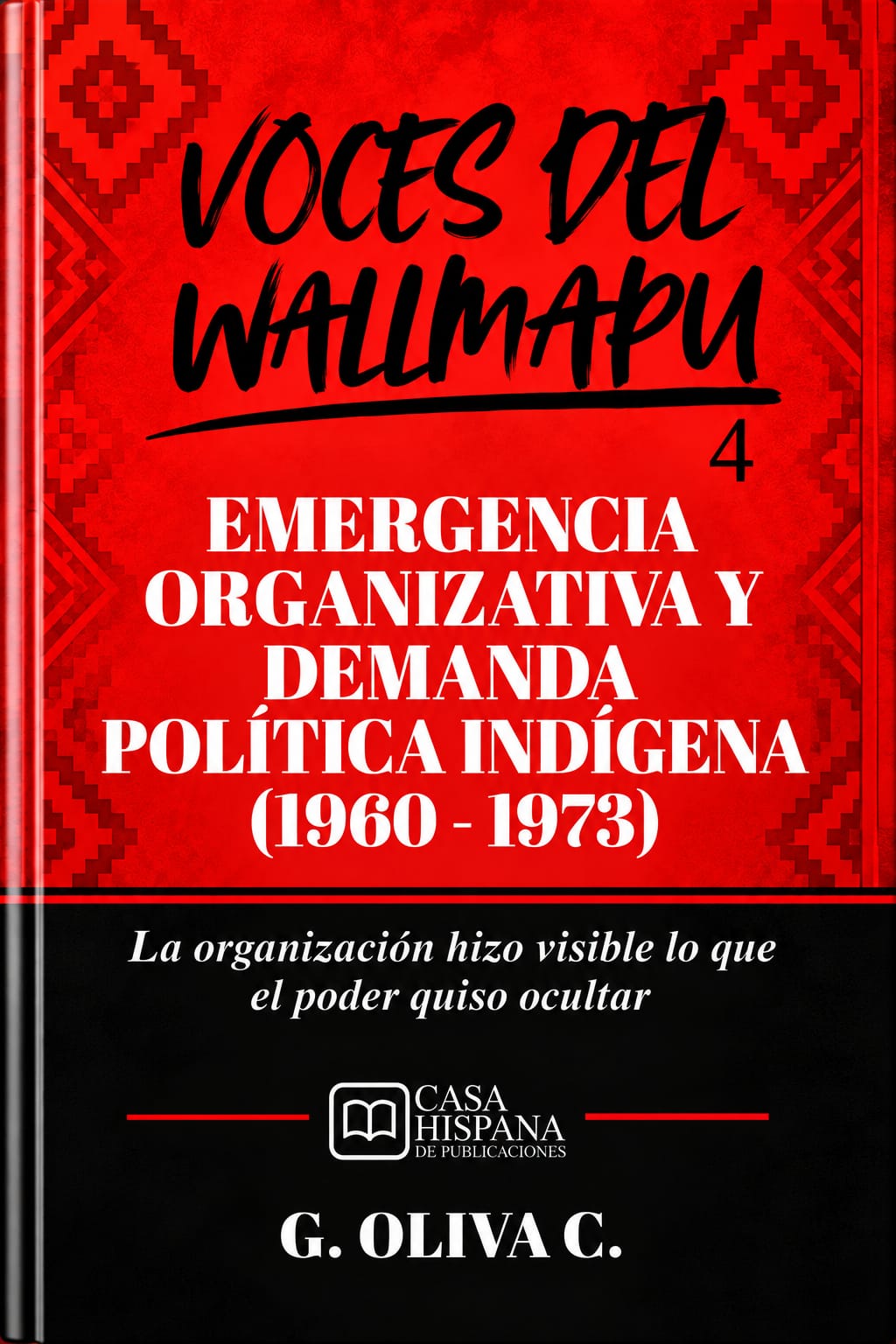
Organisational Emergence and Indigenous Political Demand (1960–1973) addresses a decisive period in the contemporary history of the Mapuche people in Chile. After decades marked by territorial reduction into the reducciones (the reservation-like land settlements imposed by the Chilean State), by the fragmentation of communities and by assimilationist pressure, the sixties and the early seventies opened up a different landscape. The Mapuche question began to be voiced with renewed force in the public arena, linking long-standing territorial demands to new forms of social organisation, peasant mobilisation, political participation and Indigenous claims. This fourth volume analyses precisely that transition. The Mapuche people appear not merely as the object of policies designed by the State but as a social and political actor able to organise, to formulate demands, to build alliances and to contest space for their own representation. The period 1960–1973 is therefore a stage of rearticulation. Communities begin to turn problems that for decades had been experienced locally — loss of land, poverty, usurpation, territorial fragmentation and discrimination — into collective demands capable of challenging the State and Chilean society directly. The work invites us to understand this process within the far-reaching changes Chile was then undergoing. Agrarian reform, peasant unionisation, political polarisation, the growth of social movements and debates about property and structural justice all altered the national landscape. The Indigenous question began to meet the peasant question, although the two were never exactly equivalent. Therein lies one of the fundamental tensions of the period: a Mapuche might be a peasant, but his situation was not exhausted by his economic condition; there were also territory, culture, history and collective identity. From community survival to political organisation. The Mapuche rearticulation of the sixties did not arise from nothing. It had antecedents in Indigenous organisations founded during the first half of the twentieth century and in decades of community defence of land and rights. The new political conditions, however, allowed those claims to gain far greater visibility. Land remained the core of the problem. The cumulative effects of the settlement policy known as radicación, of the Títulos de Merced, of the later subdivisions and of the disputes over land held to have been usurped had produced a situation of mounting territorial pressure. In many communities, population growth and the fragmentation of holdings were making it ever harder to sustain families economically. The territorial demand then began to become a political demand as well. It was not enough to claim a single holding individually. The structures through which the distribution of land had been shaped had to be called into question. This shift is sociologically fundamental: a problem initially experienced as a particular predicament begins to be read as a shared condition. And when a community recognises that its experience forms part of a collective problem, social organisation can emerge. Agrarian reform and the Mapuche question. The Agrarian Reform is one of the contexts indispensable to understanding this period. Under the governments of Jorge Alessandri, Eduardo Frei Montalva and later Salvador Allende, the structure of rural property in Chile underwent major changes, though with differing intensity and orientation. Law 15.020 of 1962 opened a first stage of reform. Law 16.640 of 1967, enacted under the Frei Montalva government, then deepened the process considerably and established new possibilities for the expropriation and reorganisation of agricultural property. In parallel, peasant unionisation strengthened the organisational capacity of rural sectors. For many Mapuche communities this conjuncture represented an opportunity. There was, however, an important conceptual difference. The Agrarian Reform was conceived above all from the problem of agrarian structure and of the peasantry. Mapuche claims carried an additional historical charge: many communities were not simply asking for access to new land but for the restitution of areas they regarded as part of their historical territory or associated with old Títulos de Merced. Here lies one of the volume's interpretative keys. Agrarian reform and territorial restitution could meet, but they did not mean the same thing. Land recoveries and mobilisation. Towards the end of the 1960s and the beginning of the seventies, territorial demands took increasingly direct forms. Mobilisations, occupations and land recoveries multiplied. The so-called Cautinazo, particularly visible from 1970 onwards, is one of the most significant episodes of this process. Mapuche communities occupied land they had historically claimed, pressing the State to accelerate expropriations and restitutions. These actions must be understood within their context. For those who carried them out, many recoveries meant the pursuit of restitution of land lost or in dispute. For the landowners affected, they could mean illegal occupations and concrete threats to property rights. For the State, they represented a complex political problem in which legality, the Agrarian Reform, social conflict and Indigenous demands all converged. Responsible historical research must acknowledge these perspectives without reducing the period to a narrative of heroes and adversaries. Mapuche mobilisation was real. So were the conflicts it generated. The Mapuche people as a political subject. One of the most important changes of the period is the consolidation of the Mapuche as a collective political subject. The demand begins to move beyond the paternalistic petition addressed to the authorities. Communities develop their own discourses, organisations, congresses and forms of negotiation. This process marks a profound break with earlier assimilationist policies. For decades the Indigenous problem had been framed by the State through questions such as: how is the Indigenous person to be integrated? how is he to be turned into a smallholder? how is he to be incorporated into national development? Now Mapuche organisations themselves were beginning to pose another question: what rights are ours as a people with our own history, territory and identity? Although the contemporary language of Indigenous rights and self-determination did not yet have the international legal development it would later acquire, fundamental elements of a modern Indigenous political consciousness were beginning to consolidate. The Indigenous Law of 1972. A particularly significant moment was the enactment of Law 17.729 in 1972, under the government of Salvador Allende. This legislation represented an important change in State policy towards Indigenous peoples and created the Institute of Indigenous Development (IDI). It sought to respond to demands concerning land, development and the protection of communities. Its importance does not lie solely in its specific provisions. It also represents a change in the way the Indigenous question was understood. The State was beginning to recognise that here was a problem which could not be resolved solely through the general categories applied to the peasantry. The short span between its enactment and the coup d'état of September 1973, however, severely limited any assessment of its long-term results. History changed abruptly once again. Indigenous identity and collective consciousness. From a sociological point of view, the organisational emergence of this period allows us to observe a particularly telling phenomenon: the public reconstruction of identity. After decades in which discrimination had led some people to render their origins invisible, collective organisation made it possible to turn Mapuche identity progressively into a ground for claims. What might have been used socially as a stigma also began to become a source of mobilisation. Territory, surname, community, memory and culture took on new political meanings. This does not mean that all Mapuche held the same positions. The Mapuche world remained diverse. There were religious, territorial, generational, economic and political differences. For that very reason, speaking of “the Mapuche movement” calls for caution. There were diverse Mapuche movements, organisations and strategies. Between class and identity. The period was deeply shaped by the political categories of its time. The left tended to read much of rural reality through the categories of class, peasantry, exploitation and property structure. These tools made it possible to understand real aspects of poverty and inequality. But they could prove insufficient to account fully for the Indigenous experience. A Mapuche peasant might share economic conditions with a non-Indigenous peasant, yet he also carried a collective history bound up with occupation, territorial reduction, language, culture and memory. The Mapuche question therefore lay at the intersection of class and identity. This tension would remain relevant through the following decades and is one of the most interesting sociological themes in the book. Church, social justice and the Indigenous world The Church was also undergoing important changes in those years. In Latin America, discussions about poverty, social justice, development and the public responsibility of Christianity took on particular intensity. Vatican II (1962–1965) and then the Medellín Conference of 1968 had a profound influence on Catholic sectors committed to peasant and Indigenous realities. In various territories, pastoral initiatives emerged geared towards social accompaniment, education and the defence of communities. The Church, however, also had to face its own history. The question was no longer only how to evangelise the Mapuche people, but how to relate to communities that were beginning to claim a voice of their own and the capacity to decide their own future. This shift has important missiological implications: to accompany does not mean to replace the other's voice. 1970–1973: acceleration and polarisation. Salvador Allende's arrival in the presidency in 1970 accelerated the Agrarian Reform and coincided with a significant rise in rural mobilisation. For Mapuche communities, a historic opportunity opened to press territorial demands with greater force. But the process unfolded within an increasingly polarised Chilean society. Landowners, peasants, political organisations, Indigenous communities, State institutions and social movements defended different and at times incompatible projects. The Araucanía once again became a territory where national and historical problems overlapped. The Mapuche question could no longer be separated from the general political crisis running through Chile. 11 September 1973 radically interrupted this process. The coup d'état and the establishment of the military dictatorship completely altered the political, social and institutional conditions within which Indigenous organisations had operated. Another stage was beginning. Rearticulating politically. The subtitle “Rearticulating politically” aptly sums up the historical meaning of the period. After the military occupation of the nineteenth century, territorial reduction and decades of assimilationist policy, Mapuche communities found in the sixties and the early seventies new possibilities for turning memory and local demands into organised collective action. Rearticulating meant rebuilding networks. It meant coming together. Forming organisations. Taking part in congresses. Engaging with and confronting the State. Reviving territorial demands. Seeking representation. And beginning to express publicly an identity that earlier policies had tried to absorb into a culturally homogeneous nation. The Mapuche people were once again beginning to speak politically in their own name. A final consideration. Organisational Emergence and Indigenous Political Demand (1960–1973) studies, in the end, a period of fundamental transition. The Mapuche question ceased to be presented solely as a problem of rural poverty, small holdings or cultural integration. It began once again to be territorial, political and a question of identity. The Agrarian Reform opened possibilities. Indigenous organisations built new capacities. Territorial recoveries carried the conflict into the public arena. The legislation of 1972 attempted an institutional response. And a growing collective consciousness allowed new generations to begin reinterpreting their history through different categories. The process, however, was abruptly interrupted in 1973. This fourth volume can therefore be read as the history of an unfinished rearticulation. For thirteen years, old territorial wounds met new political tools. Memory began to turn into organisation; organisation into demand; and demand into the capacity to challenge the State directly. That process would leave a deep legacy. For from then on the Mapuche question could no longer be understood merely by asking what the State ought to do about the Indigenous population. Another, far deeper question was beginning to impose itself: what would happen when Indigenous peoples themselves began to demand a direct part in defining the policies, rights and decisions affecting their territory, their identity and their future? In that transformation — from an administered population to an organised political subject — lies one of the fundamental keys to understanding not only the period 1960–1973 but also much of the Mapuche movement that would reappear and reorganise in the decades that followed…
Category
- SOCIAL SCIENCES
- HISTORY
- HISTORY OF CHILE
- CONTEMPORARY HISTORY
- MAPUCHE HISTORY
- INDIGENOUS STUDIES
- POLITICAL SOCIOLOGY
- SOCIAL MOVEMENTS
- INDIGENOUS POLICY
- INDIGENOUS RIGHTS
- AGRARIAN REFORM
- STATE AND INDIGENOUS PEOPLES
- TERRITORIALITY
- HISTORICAL MEMORY
Rights for this book
We turn publishing rights into international growth, connecting authors and publishers with new markets, new readers and new partners around the world.
Technical details
- Title
- Emergencia Organizativa y Demanda Política Indígena (1960–1973)
- Author
- G. Oliva C.
- Imprint
- Grupo Editorial Casa Hispana de Publicaciones
- Size
- 15x23cms
- Edition
- 1st edition, 2024
- Published in
- Chile
- Year of publication
- 2025
- Available languages
- Spanish, English, German, Portuguese
- Binding
- Paperback with flaps
- Pages
- 567
- Format
- Print book
- Language
- Spanish