Description
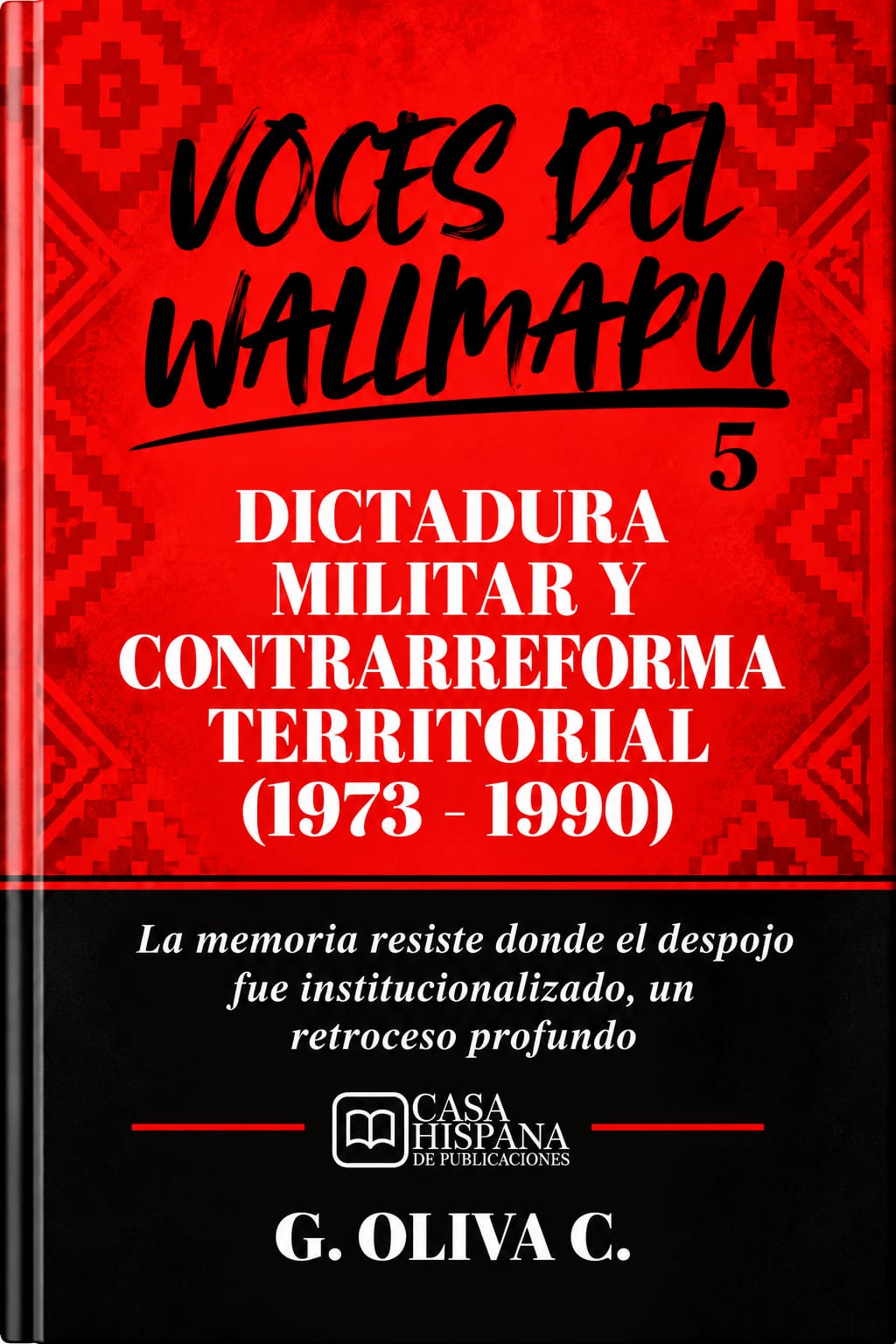
Military Dictatorship and Territorial Counter-Reform (1973–1990) examines one of the most critical periods in the contemporary history of the Mapuche people in Chile. The coup d'état of 11 September 1973 did not mean only the end of Salvador Allende's government and the establishment of a military dictatorship; it also produced a profound rupture in the political, territorial and organisational dynamics that had gathered particular intensity during the Agrarian Reform. For many Mapuche communities, the change of regime meant the interruption of processes of territorial recovery, a radical shift in Indigenous policy and the installation of a new legal and economic model of landownership. The subtitle A profound setback states precisely the historical thesis that guides this volume. From the point of view of the communities that in the preceding years had taken part in processes of organisation, mobilisation and land recovery, the new period meant a heavy loss of political and social ground. A rigorous scholarly reading, however, requires the process to be understood within a broader national transformation: the dictatorship altered the relations between State, society, property and economy across the whole of Chile, and Mapuche territory was deeply cut across by that restructuring. This volume therefore proposes to study the years 1973–1990 through a fundamental question: what happened to Mapuche communities when the Agrarian Reform was interrupted and replaced by a policy oriented towards individual property, economic liberalisation and territorial reorganisation? 1973: the rupture of a process. To grasp the impact of the military coup on the Mapuche people it is necessary to recall the scene immediately preceding it. During the sixties and the early seventies, the communities had undergone a significant process of organisational rearticulation and territorial mobilisation. The Agrarian Reform made it possible to recover or to incorporate land for communities and peasants, while Law 17.729 of 1972 established a new Indigenous institutional framework and created the Institute for Indigenous Development (Instituto de Desarrollo Indígena). The coup d'état abruptly interrupted that process. Political and social organisations were taken over or dissolved. Peasant and Indigenous leaders were exposed to persecution and repression within the general context of human rights violations that characterised the dictatorship. The rural world of southern Chile was not spared. The communities that had taken an active part in land recoveries and in organisations tied to the Agrarian Reform found themselves in a wholly different setting, one in which the scope for public mobilisation was severely restricted. The territorial question was transformed once more. If between 1960 and 1973 the debate had turned increasingly on reform, recovery and organisation, after 1973 a policy of counter-reform and restructuring of property began to take shape. The agrarian counter-reform. One of the central features of the period was the review of the expropriations carried out during the Agrarian Reform. The military regime implemented a process of regularisation and restitution of part of the expropriated estates, while others were subdivided, allocated or transferred under new arrangements. This process affected the peasantry as a whole, but it took on a specific character in Mapuche territories. For certain communities, land recovered in the previous period once again became the object of dispute or was reorganised within the new agrarian order. The concept of territorial counter-reform used in this volume makes it possible to widen the analysis beyond the traditional agrarian counter-reform. What was at stake was not merely the reversal of particular expropriations. The way the State conceived the relationship between land, property, community and development was being altered once again. The tendency began to shift away from a social and communal understanding of certain rural spaces towards a model in which individual property and the free circulation of land would take on growing centrality. Decree Law 2.568 and the division of the communities. One of the fundamental legal events for understanding the period was the promulgation of Decree Law 2.568 of 1979, later amended by Decree Law 2.750. This legislation drove the division of Indigenous lands and the conversion of communal forms of property into individual titles. The change carried enormous consequence. It was not merely an administrative adjustment. The Mapuche community had historically developed a territorial relationship in which land, kinship, memory, social organisation and identity were deeply bound together. Turning communal land into individual holdings meant introducing a different logic. From the government's point of view, individualisation could be presented as a mechanism for granting legal certainty, easing individual access to property and promoting economic integration. From the point of view of the Indigenous organisations that opposed the measure, it meant weakening the territorial and communal basis of Mapuche identity. This tension is one of the volume's fundamental analytical cores. When the community disappears in law The 1979 legislation also contained an especially significant feature: once certain reserves had been divided, the land and its owners ceased to be regarded as Indigenous for legal purposes, a formulation that drew deep criticism. The problem went beyond property. A more basic question arose: can an administrative definition legally transform a historical identity? A person does not culturally cease to be Mapuche because a holding is subdivided. Yet when the State alters the categories through which it legally recognises a community, it can weaken collective mechanisms of protection. Territorial division could then also become institutional fragmentation. Families that had previously shared a communally recognised space came to hold individual plots. Over time these could be subdivided again through inheritance, sale or other transactions. The territory thus entered a new process of fragmentation. Territory and identity. From a sociological standpoint, this process again brings into view a matter that runs through the whole of Mapuche history: land is not merely an economic asset. Memory, kinship, community, culture and identity converge in it. When public policy reads territory solely through criteria of productivity or individual ownership, it can leave out fundamental aspects of Indigenous experience. The territorial counter-reform therefore had consequences that went well beyond the legal sphere. The fragmentation of the communities could affect forms of cooperation, authority, cultural transmission and the collective use of space. The problem was not simply one of determining how many hectares corresponded to each family. The question was also what became of the community when the territory that helped hold it together was progressively individualised. The economic transformation of the Araucanía. The period 1973–1990 also coincided with a profound transformation of the Chilean economic model. The liberalisation of markets, the privatisation of activities and the promotion of export sectors reshaped the country's productive structure. In south-central Chile, the forestry sector took on particular importance. Decree Law 701 of 1974 established afforestation incentives that favoured the expansion of plantations, especially of fast-growing species. Over the following decades, the forestry industry acquired a significant territorial presence in regions historically tied to Mapuche communities. Historical precision must be maintained: not all forestry expansion took place on Indigenous land, nor can every contemporary territorial conflict be attributed directly to the policies of the dictatorship. Even so, the forestry model profoundly altered the economy and the landscape of south-central Chile and would later become one of the salient components of territorial and environmental controversy. A further side of the problem appears here: territory, property and natural resources began to be ever more tightly bound together. Environmental transformation. The expansion of large forestry plantations would later generate debates about water, biodiversity, erosion, fires, the availability of soils and the transformation of the landscape. For Indigenous communities whose relationship with territory carries cultural and ecological weight, these changes have consequences that cannot be measured by economic indicators alone. The territorial conflict thus began to acquire a social and environmental character as well. This would develop far more forcefully after 1990, but its economic and territorial antecedents lie in part within the period under study. Repression and organisational weakening. The dictatorship also meant severe restrictions on the scope for political organisation. After the intense mobilisation of the 1960–1973 period, the communities entered a setting marked by surveillance, repression and the curtailment of social participation. The impact was especially severe on leaders tied to peasant movements, political organisations and processes of territorial recovery. Mapuche organisation did not disappear, however. This point is fundamental. A reading focused solely on repression would once again present the Mapuche people as a passive subject. The reality was more complex. Despite the restrictions, new forms of organisation and resistance began to emerge. The Mapuche Cultural Centres and Ad Mapu. The policy of dividing Indigenous lands provoked a significant reaction. In 1978 the Mapuche Cultural Centres (Centros Culturales Mapuches) emerged, initially tied to the sheltered spaces afforded by sectors of the Catholic Church. These organisations played a significant part in defending the communities against the policies of territorial division. Part of this movement subsequently gave rise to Ad Mapu, an organisation that would become one of the most important Indigenous actors of the 1980s. This process demonstrates once again a historical feature of remarkable continuity: every policy of dismantling also produced new forms of organisation. Resistance could no longer operate under the same political conditions as in the early seventies. It had to use other languages. Culture. Identity. Rights. Territorial defence. Community organisation. These concepts began progressively to converge. Culture as a space of resistance. During the dictatorship, cultural identity took on particular political weight. When party-political and social mobilisation was restricted, culture could become a space of resistance. Defending Mapudungun. Reclaiming ceremonies. Strengthening community organisations. Recovering memory. Defending the land. All these actions could take on cultural and political meaning at once. Mapuche identity began to grow stronger as a category through which demands could be articulated beyond the traditional party divisions. This process would be fundamental for understanding the Indigenous movement that would emerge during the democratic transition. Church, human rights and the Mapuche people. The Church also played a relevant part during this period. Catholic and Protestant sectors took part in the defence of human rights, in accompanying communities and in supporting those who were persecuted. In the Mapuche sphere, certain ecclesial spaces helped to provide conditions in which organisations and cultural reflection could develop. This experience once again compels us to take historical stock of the role of the Church. In earlier periods, certain missionary practices had been able to contribute to processes of cultural assimilation. Now Christian sectors also began to take part in the defence of communities, of human rights and of Indigenous dignity. This shift is significant from a theological and missiological standpoint. The Church had not only to ask how to evangelise the Mapuche people. It also had to ask how to accompany them when their rights and their communal forms were under threat. Human rights and the Indigenous question. The Mapuche situation under the dictatorship must be placed within the general problem of human rights in Chile between 1973 and 1990. The violations committed by State bodies affected people from different social and political sectors, members of the Mapuche people among them. But Indigenous analysis also brings in a collective dimension. To individual rights — life, bodily integrity, liberty, due process — were added questions bound up with land, community, culture and identity. In those years, the international law of Indigenous peoples had not yet reached the development it would later attain. ILO Convention 169 would only be adopted in 1989, and Chile would ratify it many years later. Internationally, however, an important conceptual shift was beginning: Indigenous peoples were ceasing to be regarded merely as populations destined for integration and were progressively coming to be recognised as collective subjects of rights. Taking stock of the period 1973–1990 Applying once again the notion of taking stock, this fifth volume finds a complex picture. What did the dictatorship leave behind in relation to the Mapuche people? It left the interruption of earlier processes of territorial recovery. It left an agrarian counter-reform. It left new divisions of communal land. It left territorial fragmentation. It left organisational restrictions. It left profound economic transformations. It left a growing forestry presence in south-central Chile. But the inventory does not end there. It also left new organisations. New leaderships. New discourses on identity. A growing awareness of collective rights. New relations between the Church, human rights and the communities. And a generation that would reach democracy with questions the State would have to face all over again. 1990: democracy, but not a solution. The return to democracy in March 1990 formally closed the dictatorial period. But it did not close the Mapuche question. The territorial, economic and legal structures built during the preceding years remained in place. This continuity is fundamental for understanding the period that followed. Democracy inherited a historical problem that had passed through multiple stages: military occupation → territorial reducción (the reservation-like land settlements imposed by the Chilean State) → assimilation → political reorganisation → Agrarian Reform → counter-reform → division of the communities. Each stage had left its own layers of memory and conflict. For that reason, 1990 was not a point zero. It was the beginning of a new negotiation between the democratic State and an Indigenous movement that had survived seventeen years of authoritarian rule and that arrived with renewed territorial, cultural and political demands. Closing consideration Military Dictatorship and Territorial Counter-Reform (1973–1990) is an indispensable chapter for understanding the contemporary Mapuche question. The importance of the period lies not only in what was destroyed or reversed. It lies also in the new structures that were created. The dictatorship changed the political regime. The counter-reform changed property. Indigenous legislation changed territorial organisation. The new economic model changed the productive landscape. And the communities responded by developing new forms of resistance. For that reason, the subtitle A profound setback does not mean that Mapuche history moved backwards in a straight line. It means that processes of territorial recovery, participation and recognition begun earlier were interrupted or profoundly altered. Yet in the midst of that setback something historically significant took place: the Mapuche movement began to rebuild itself from identity, culture, territory and rights. This shift would set the scene for the demands of the decades that followed. When Chile recovered democracy in 1990, the Indigenous question could no longer be framed solely in terms of rural poverty or integration. It was being posed ever more clearly in terms of people, territory, identity, memory and collective rights. That is perhaps the most paradoxical legacy of the period. A regime that drove the legal division of communities ended up facing a growing reassertion of collective Mapuche identity. A model that privileged individual property contributed indirectly to placing territory once again at the centre of Indigenous debate. And a stage marked by severe political restrictions left behind, at its close, organisations ready to demand recognition under democracy. Thus 1973–1990 represents rupture, counter-reform, fragmentation and resistance all at once. Understanding those four aspects is indispensable for interpreting the next chapter of this history: the encounter between the Mapuche people and Chilean democracy, its expectations of recognition and the deep frustrations that would begin to accumulate during the transition…
Category
- SOCIAL SCIENCES
- HISTORY
- CONTEMPORARY HISTORY OF CHILE
- MAPUCHE HISTORY
- INDIGENOUS STUDIES
- MILITARY DICTATORSHIP
- POLITICAL SOCIOLOGY
- HUMAN RIGHTS
- INDIGENOUS POLICY
- TERRITORIALITY
- AGRARIAN COUNTER-REFORM
- STATE AND INDIGENOUS PEOPLES
- SOCIAL MOVEMENTS
- HISTORICAL MEMORY
Rights for this book
We turn publishing rights into international growth, connecting authors and publishers with new markets, new readers and new partners around the world.
Technical details
- Title
- Dictadura Militar y Contrarreforma Territorial (1973–1990)
- Author
- G. Oliva C.
- Imprint
- Grupo Editorial Casa Hispana de Publicaciones
- Size
- 15x23cms
- Edition
- 1st edition, 2024
- Published in
- Chile
- Year of publication
- 2025
- Available languages
- Spanish, English, German, Portuguese
- Binding
- Paperback with flaps
- Pages
- 567
- Format
- Print book
- Language
- Spanish