Description
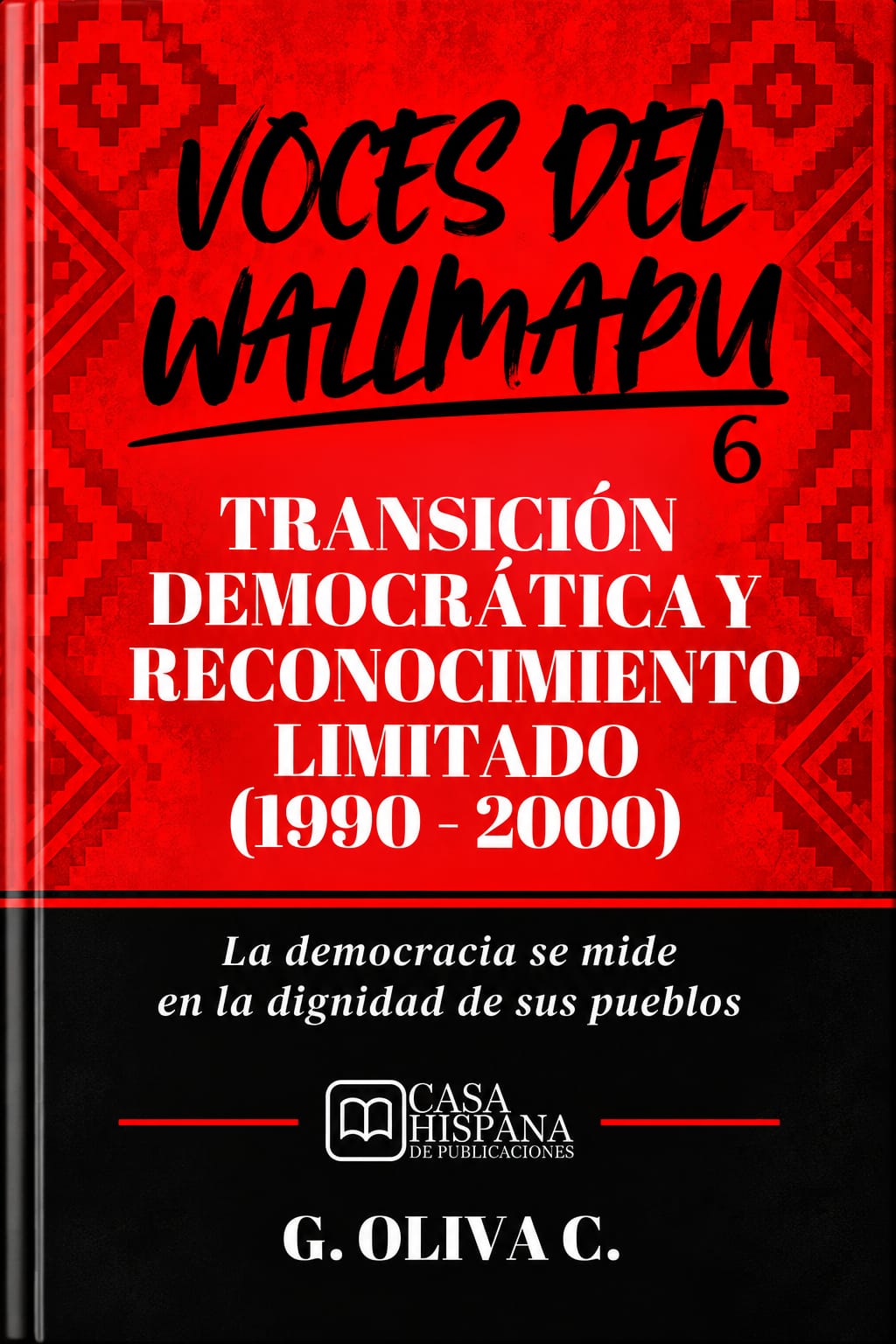
Democratic Transition and Limited Recognition (1990–2000) examines a decisive decade in the transformation of relations between the Chilean State and the Mapuche people. The return to democracy in 1990 opened significant expectations after seventeen years of military dictatorship. For Indigenous organisations, the new stage represented the chance to rebuild spaces of participation, to review the inherited territorial policies and to move towards a legal and political recognition that would leave behind the old paradigm of assimilation. The balance sheet of the decade, however, shows a more complex reality: there were important institutional advances, but also structural limits that ended by generating frustration, mistrust and new forms of mobilisation. The volume's subtitle —Formal recognition, but insufficient— aptly sums up this tension. During the nineties, Chile moved from a policy that had favoured the division of communities towards a framework that explicitly recognised the existence of Indigenous peoples and cultures, created a specialised institutional apparatus and established mechanisms for the protection and acquisition of land. But that recognition remained limited. During that decade Chile did not manage to establish constitutional recognition of Indigenous peoples, nor did it then ratify ILO Convention 169. Chilean ratification would come only in 2008, entering into force in 2009. This sixth volume cannot therefore be read simply as the history of an advance, nor as the history of a failure. It is, above all, the history of a democratic opportunity only partly realised. 1990: democracy and Indigenous expectations. The democratic transition met a profoundly transformed Mapuche society. The Indigenous organisations that had held out under the dictatorship came to the new stage with accumulated political experience. Defending communities against the policies of territorial division had helped to strengthen concepts such as identity, territory, culture and collective rights. The international scene was also changing. During the 1980s and 1990s, Indigenous peoples gained growing international visibility. Convention 169 of the International Labour Organization, adopted in 1989, marked a fundamental break with the old integrationist paradigm: it recognised the identity of Indigenous peoples, their participation and the importance of their institutions and territories. In Latin America, moreover, various States began to introduce constitutional reforms bearing on cultural diversity and Indigenous rights. Chile was entering democracy precisely when international debate was beginning to shift from the integration of the Indigenous person towards the recognition of Indigenous peoples as collective subjects. This shift raised expectations. The question was no longer solely how to bring communities into national development. Another was starting to be posed: how is a democracy to be built that is capable of recognising within itself the existence of peoples with their own identities, memories and specific rights? The Nueva Imperial Agreement. One of the fundamental antecedents of the new period was the Nueva Imperial Agreement, signed in December 1989 between the then presidential candidate Patricio Aylwin and representatives of Indigenous organisations. The agreement symbolised a political commitment between the future democratic government and Indigenous peoples. Indigenous organisations took on a role within the democratic institutional process, while the new government undertook to promote Indigenous legislation, to advance recognition and to establish an institutional framework capable of addressing their demands. Its historical importance was considerable. After years of authoritarian rule, the State once again recognised Indigenous organisations as legitimate political interlocutors. Later experience, however, would reveal a difficulty that ran through the whole decade: the distance between expectations, political commitments and the institutional capacity to make them real. That distance is one of the keys to understanding the growing disenchantment that would begin to show towards the end of the nineties. The Indigenous Law of 1993. The chief legal advance of the period was the promulgation of Law No. 19.253, known as the Indigenous Law (Ley Indígena), on 5 October 1993. The law laid down rules on the protection, promotion and development of Indigenous people and created the National Indigenous Development Corporation (CONADI). It also recognised as the principal Indigenous ethnic groups of Chile a number of peoples present in the national territory, and established State duties relating to their culture, their lands and their development. The importance of this legislation is beyond dispute. After the divisive policies of the dictatorship, the democratic State began to build a framework directed towards the protection of Indigenous land and cultural recognition. CONADI became a central institution for implementing public policy, managing territorial mechanisms, promoting development and establishing a permanent institutional relationship between the State and Indigenous peoples. The change was significant. The Indigenous question ceased to be placed exclusively within peasant or welfare categories and began to acquire an institutional form of its own. But it is precisely here that the limits appear. Indigenous recognition, but not full political recognition. Law 19.253 was an advance, yet its language also reflected the political constraints of the transition. The legal text used the concept of “ethnic groups” to refer to the Indigenous groups recognised by the State, instead of establishing constitutional recognition of them as peoples with collective political rights. The difference is not merely terminological. The word “people” carries significant implications within contemporary international law, especially in relation to collective identity, participation and self-determination. The State recognised cultural diversity. It recognised Indigenous lands. It recognised communities. But it did not move fully towards a political redefinition of Chile as a multicultural or plurinational society. Recognition therefore remained situated chiefly within cultural, social and administrative dimensions, without substantially transforming the political architecture of the State. From this comes the concept that guides the volume: limited recognition. Land returns to the centre. The territorial question continued to be the main point of tension. The Indigenous Law created mechanisms intended to protect and enlarge Indigenous lands, above all through the Indigenous Land and Water Fund administered by CONADI. This instrument allowed the State to acquire holdings in answer to particular community claims. The mechanism, however, progressively revealed its difficulties. The accumulated demand was considerable. The procedures could be long. The resources were limited. And acquiring land through the market introduced a paradox: the State was attempting to resolve historical conflicts by buying, at contemporary prices, land whose loss was precisely the object of historical dispute. The territorial problem thus began to show a growing complexity. For the State, there were administrative procedures. For the communities, there were territorial memories and historical claims. When the timescales of the two did not coincide, frustration appeared. Economic development versus territorial rights. During the nineties a further tension emerged that would prove fundamental in the following decades: the relationship between development projects, investment and Indigenous rights. Chile was going through a period of strong economic growth and expanding infrastructure. In the south of the country, hydroelectric, forestry and infrastructure projects began to come into contact with territories where Indigenous communities lived. One of the most emblematic cases was the Ralco hydroelectric project, developed in the Alto Biobío. The project affected the ancestral territory of Pehuenche communities and provoked a national and international controversy. Ralco set two conceptions of development against one another. On one side, the State and the company promoted energy generation, infrastructure and economic growth. On the other, Pehuenche families and organisations raised problems bearing on territory, burial grounds, cultural spaces, displacement and the right of communities to decide on projects that profoundly affected their ways of life. The conflict exposed the limitations of the institutional framework created only a few years earlier. The existence of an Indigenous Law did not automatically guarantee that Indigenous rights would prevail, or be adequately weighed, when they came into tension with large projects deemed strategic for national development. Lumaco, 1997: a turning point. Towards the end of the decade another fundamental event occurred. In 1997 the Lumaco conflict, bound up with territorial claims and actions against forestry companies, marked a turning point in the relationship between certain Mapuche organisations and the State. The burning of lorries belonging to a forestry company had a great public impact. From that moment a new stage of the conflict began to take shape. Political language changed as well. Concepts such as territory, autonomy and territorial recovery began to acquire greater presence within sectors of the Mapuche movement. That same context saw the emergence of the Coordinadora Arauco-Malleco (CAM), an organisation that over the following years would develop a more confrontational strategy and a deep critique of State institutions. This shift did not represent the whole of the Mapuche people. It is essential to keep that distinction. Mapuche communities and organisations never formed a homogeneous political bloc. There were institutional, electoral, cultural, communal and territorial strategies that differed widely. Nevertheless, the rise of more radicalised organisations revealed an underlying problem: part of the Indigenous movement was beginning to regard the institutional path built during the democratic transition as insufficient. From recognition to frustration. Here appears one of the principal sociological readings of the period. Expectations carry political weight. When a society lives for years without recognition, any institutional advance can generate hope. But when formal recognition fails to produce changes perceived as sufficient, that same hope can turn into political frustration. During the nineties precisely this dynamic unfolded. Democracy had promised dialogue. There was a new law. There was CONADI. There were land funds. There were cultural programmes. But territorial conflicts persisted. Poverty persisted. Discrimination persisted. And economic projects continued that some communities regarded as incompatible with their territorial rights. The distance between legal recognition and everyday experience began to become a political problem. Mapuche identity and a new generation. At the same time, the nineties were a decade of considerable revival of identity. New generations of students, professionals, leaders and organisations began to reinterpret Mapuche history through broader categories. Identity gradually ceased to be formulated solely around the rural community. The urban Mapuche world gained greater visibility. Language, memory, symbols and territoriality began to occupy new cultural and political spaces. The concept of Wallmapu also gained growing presence, used to express a historical and territorial understanding of Mapuche space that reaches beyond contemporary administrative divisions. The Indigenous movement was thus beginning to move from demands centred exclusively on land towards a discourse that took in territory, people, identity, autonomy and collective rights. This shift would have enormous consequences during the twenty-first century. State, security and judicialisation. Towards the end of the nineties, the State began to face a new difficulty. How should it respond when a territorial demand is expressed through actions that breach the law in force? The problem began to shift from Indigenous policy towards public security and criminal justice. That passage would prove decisive. When territorial conflict comes to be read chiefly as a problem of public order, the scope for political dialogue can narrow. At the same time, no democratic State can ignore crimes or violence against persons and property. A tension thus arises that would continue to run through the following decades: how is the rule of law to be guaranteed without reducing a historical and political conflict to a purely policing matter? Chilean democracy had not yet found a satisfactory answer. A decade of advances and limits. Any assessment of the period 1990–2000 must avoid two extreme readings. It would be wrong to claim that nothing changed. A great deal changed. The Indigenous Law of 1993 was a significant advance. CONADI created an institutional framework that had not existed. Territorial and cultural policies were developed. The State began publicly to recognise Indigenous diversity. Organisations recovered democratic spaces of participation. But it would be equally wrong to maintain that these advances resolved the Mapuche question. There was no constitutional recognition. Convention 169 had still not been ratified. Territorial demands exceeded institutional capacity. Inequalities persisted. The conflicts surrounding economic projects revealed the limitations of the mechanisms of participation. And towards the end of the decade confrontation began to grow. Taking stock of the transition. Applying once more the idea of taking stock, the period leaves contradictory results. There was democracy. There was legal recognition. There was a new institutional framework. There were land policies. There was cultural revival. But much also remained outstanding: constitutional recognition, effective participation, a long-term territorial settlement, sufficient protection against investment projects, the overcoming of discrimination and the building of a political relationship resting on greater trust. The fundamental problem was possibly that the State advanced in administering the Indigenous question, but far less in structurally transforming the relationship between Indigenous peoples and the State. To administer means creating programmes, institutions and funds. To recognise politically implies something deeper: accepting that there exists a collective subject whose history, territory and identity require permanent forms of participation. Democratic Transition and Limited Recognition (1990–2000) represents a decade of hope, institutional advance and opportunities only partly realised. Chile recovered its democracy and opened spaces that had remained closed throughout the dictatorship. The State formally recognised the existence of Indigenous communities and established mechanisms to protect lands and cultures. But recognition remained incomplete. Democracy made it possible to speak. It did not yet manage to learn fully how to listen. The institutional framework made it possible to process demands. It did not manage to resolve the historical conflict lying behind many of them. Public policy recognised cultural diversity. It did not go so far as to transform profoundly the political relationship between the State and Indigenous peoples. This contradiction explains a good deal of what happened afterwards. When the expectations created during the transition began to meet institutional slowness, the persistence of territorial conflicts and the expansion of economic projects over spaces claimed by communities, sectors of the Mapuche movement began to look for different strategies. Some remained within the institutional framework. Others strengthened cultural and territorial organisations. Others adopted more radical positions. The Mapuche response was once again diverse. But one thing was beginning to become clear as the twentieth century closed: cultural recognition without a sufficient answer on territory, participation and collective rights could hardly close a conflict built over more than a century. In this sense, the period 1990–2000 is a fundamental bridge between two epochs. On one side, it closes the historical cycle of dictatorship and openly divisive policies. On the other, it opens the contemporary cycle of recognition, territorial demands, revival of identity, judicialisation and growing conflict. The great historical lesson of this decade is, perhaps, that recognising the existence of a people is only the first step. The real challenge begins afterwards: building the political, legal and social conditions for that recognition to have concrete consequences for their territory, their culture, their participation and their collective dignity. Therein lie both the advance and the limit of the Chilean democratic transition in the face of the Mapuche people: recognition was necessary; recognising insufficiently was not enough to settle the historical debt…
Category
- SOCIAL SCIENCES
- CONTEMPORARY HISTORY
- HISTORY OF CHILE
- MAPUCHE HISTORY
- INDIGENOUS STUDIES
- POLITICAL SOCIOLOGY
- INDIGENOUS RIGHTS
- DEMOCRATIC TRANSITION
- INDIGENOUS POLICY
- TERRITORIALITY
- SOCIAL MOVEMENTS
- STATE AND INDIGENOUS PEOPLES
- HUMAN RIGHTS
- HISTORICAL MEMORY
Rights for this book
We turn publishing rights into international growth, connecting authors and publishers with new markets, new readers and new partners around the world.
Technical details
- Title
- Transición Democrática y Reconocimiento Limitado (1990–2000)
- Author
- G. Oliva C.
- Imprint
- Grupo Editorial Casa Hispana de Publicaciones
- Size
- 15x23cms
- Edition
- 1st edition, 2024
- Published in
- Chile
- Year of publication
- 2025
- Available languages
- Spanish, English, German, Portuguese
- Binding
- Paperback with flaps
- Pages
- 563
- Format
- Print book
- Language
- Spanish