Description
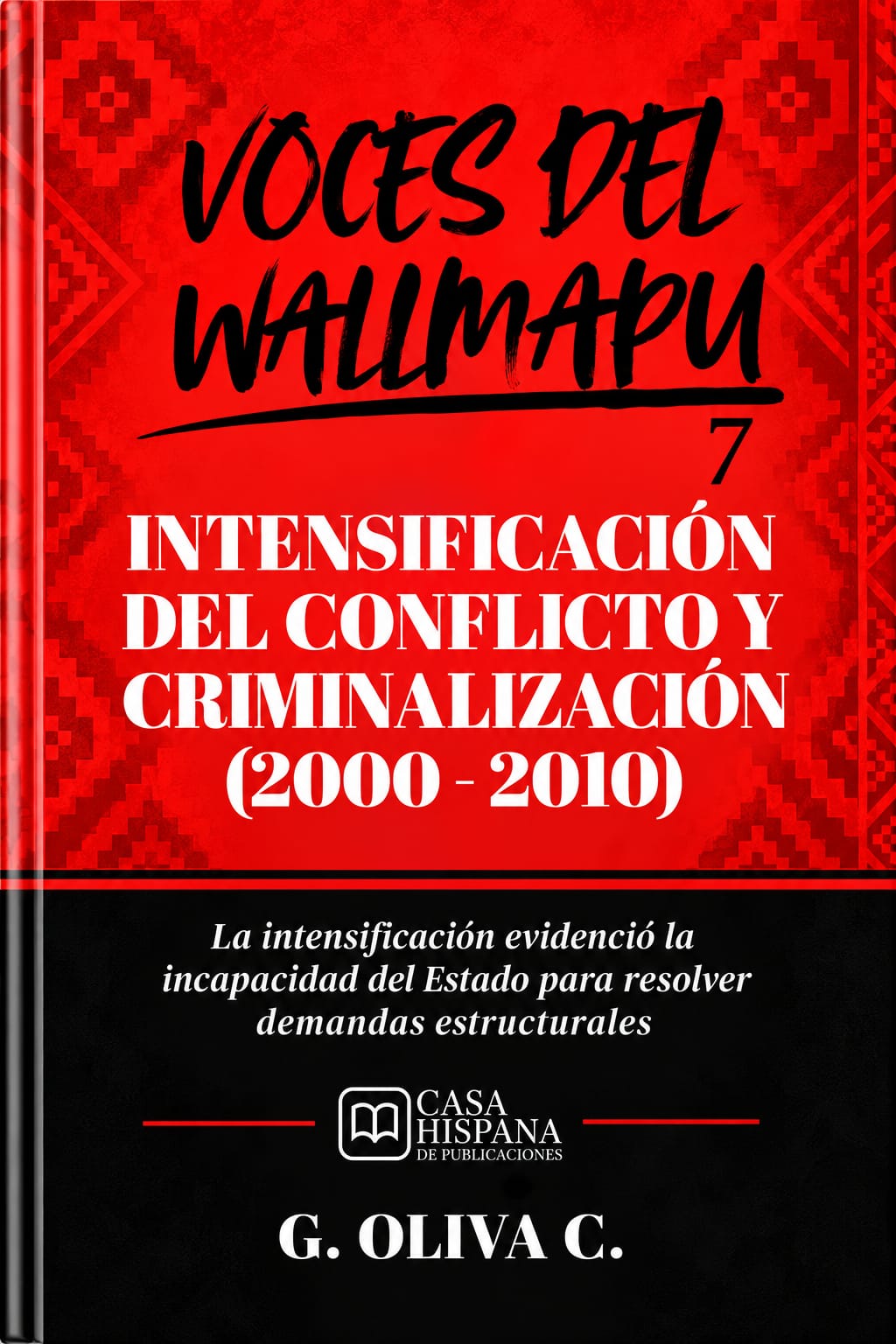
Intensification of the Conflict and Criminalisation (2000–2010) examines one of the most complex decades in the contemporary history of relations between the Chilean State and the Mapuche people. If the nineties were marked by the return to democracy, the 1993 Indigenous Act and the building of a new institutional framework, the beginning of the twenty-first century showed with growing clarity the limits of that model. Expectations of recognition and of a territorial settlement coexisted with new mobilisations, occupations of estates, actions against forestry companies, court proceedings and a State response in which policing and criminal prosecution came to weigh ever more heavily. The 2000–2010 period is, for that reason, a turning point. What is known as the Mapuche question ceased to appear primarily as a matter of Indigenous policy, rural development or cultural recognition and began to settle permanently into the debate on public safety, public order, violence, human rights and the application of criminal law. At the same time, Mapuche organisations gained greater national and international visibility, while concepts such as territory, autonomy, self-determination and collective rights came to occupy an increasingly prominent place in contemporary Indigenous discourse. The subtitle High public visibility and judicialisation sums up this transformation. The conflict became more visible, but also more judicialised. And in that shift one of the main tensions running through this volume emerged: to what extent can a criminal-law response resolve a conflict with historical, territorial, social and political roots? From recognition to conflict. The new century began with a contradiction. Since 1993 Chile had had an Indigenous Act, the National Indigenous Development Corporation (CONADI) and State mechanisms intended to respond to territorial demands. Many communities, however, considered that progress was too slow or insufficient given the historical scale of the claims. The territorial problem remained at the centre. Buying and transferring land through State mechanisms made it possible to meet some demands, but it did not produce a general settlement. To this were added disputes involving forestry companies, energy projects, private property and the use of natural resources. This accumulation of problems contributed to the growing radicalisation of certain sectors. An academic distinction must be established here: the Mapuche people are not a homogeneous political actor. Over this decade there coexisted organisations that favoured institutional dialogue, communities that turned to administrative and judicial mechanisms, cultural movements, territorial organisations and groups that regarded strategies of direct confrontation as legitimate. Confusing those expressions would mean attributing to an entire people the actions of specific organisations. Territory and the new Mapuche mobilisation. Over these years territorial demands took on a broader political formulation. Land remained fundamental, but the concept of territory came progressively to be used with greater force. The difference is significant. Land can refer to a particular estate. Territory takes in history, community, politics, culture and the environment. Within certain sectors of the Mapuche movement the claim thus began to shift from the recovery of specific properties towards discourses of territorial control, autonomy and territorial reconstruction. Organisations such as the Coordinadora Arauco-Malleco (CAM), which had emerged towards the end of the previous decade, gained particular visibility through actions of territorial recovery and confrontation with forestry companies and landowners. Once again, however, it is essential to avoid generalisations. The CAM's strategy did not represent the Mapuche movement as a whole, and within the communities themselves there were significant differences over the legitimate means of pursuing territorial claims. This diversity is a central element of any rigorous historical analysis. Forestry companies and territorial conflict. The presence of the forestry industry became one of the most visible components of the conflict. Pine and eucalyptus plantations had expanded for decades across south-central Chile, initially favoured by State forestry-promotion policies. During the 2000s, certain estates belonging to forestry companies began to become the targets of territorial claims. For some communities, those spaces formed part of territories historically lost. For the companies, they were properties acquired and protected under the legal order in force. For the State a particularly complex difficulty arose: how should it respond when a historical claim comes into conflict with property rights recognised in law in the present? This question runs through much of the period. The conflict could not be resolved simply by reading the past, but neither could it be understood by ignoring that past. From protest to criminal law One of the most contested features of the decade was the growing resort to criminal-law instruments in the face of certain actions linked to the conflict. Arson, attacks on property, threats and other conduct were the object of investigation and criminal prosecution. The State has, of course, a duty to investigate crimes and to protect the rights and safety of everyone. The academic and legal problem arises when it must be determined which legislation is to be used, under what guarantees and with what proportionality. Here the application of Law No. 18.314, known as the Anti-Terrorism Act, becomes especially relevant. This statute had been enacted under the military dictatorship in 1984 and was subsequently amended under democracy. During the decade of the 2000s it was applied in some proceedings connected with actions attributed to Mapuche activists. Its use generated strong national and international controversy. The debate was not about whether the offences should be investigated. The question was whether certain acts related to territorial claims had the features required to be dealt with under anti-terrorism legislation, and whether the procedures used fully respected the guarantees of due process. The case of the lonkos. One of the most representative episodes of this judicialisation was the prosecution of Pascual Pichún and Aniceto Norín, both lonkos (a lonko is the head of a lof, the basic Mapuche social and territorial unit). Both Mapuche leaders were convicted of the offence of terrorist arson threat in a case that would later acquire international significance. Years after the period analysed in this volume, the Inter-American Court of Human Rights, in the 2014 case of Norín Catrimán et al. v. Chile, held that Chile had violated a range of rights in criminal proceedings brought against Mapuche leaders and activists under anti-terrorism legislation. The Court examined, among other matters, the principle of legality, the presumption of innocence, equality and non-discrimination, and judicial guarantees. Although the judgment belongs to a later stage, it is essential for a historical assessment of the proceedings that took place during the decade of the 2000s. Judicialisation was no longer only a domestic controversy. It was also beginning to become an international human rights problem. Operación Paciencia. Under the government of Ricardo Lagos, the policing and judicial strategy publicly known as Operación Paciencia, aimed at investigating members and leaders linked to the Coordinadora Arauco-Malleco, acquired particular prominence. The episode clearly reflects the shift in approach that was under way. The democratic State continued to develop Indigenous policies and land-acquisition mechanisms, but at the same time it was strengthening a policing and criminal response to actions regarded as offences. Two parallel policies were thus taking shape: dialogue and social policy on the one hand; security and criminal prosecution on the other. This duality would persist in the years that followed. The problem was that, when security came to predominate, there was a risk that the whole territorial question would begin to be read through policing categories. It is there that the concept of criminalisation which gives the volume its title arises. What does criminalisation mean? Using the term criminalisation academically demands precision. It does not mean claiming that every criminal investigation of a Mapuche person is political persecution. Nor does it mean denying that offences exist. In a democratic State, setting fire to property, using violence against people or destroying goods may legitimately give rise to criminal liability, regardless of the ethnic identity of the person responsible. The concept becomes relevant when political demands, social movements or collective identities begin to be read predominantly through criminal categories, or when there is concern about the disproportionate use of exceptional instruments. The book therefore proposes a rigorous distinction between: territorial claim, social protest, civil disobedience, ordinary crime and terrorism. These are not equivalent categories. Confusing them impoverishes historical analysis and can make it harder to build democratic responses. The death of Alex Lemún. One of the events that marked the decade most deeply was the death of the young Mapuche Alex Lemún, aged 17, in November 2002 after being shot by a Carabineros officer during a police operation connected with a territorial occupation. The case became a symbol within the Mapuche movement. Its significance went well beyond the specific circumstances of the confrontation. For many organisations, Lemún's death was evidence of an increasingly violent relationship between mobilised communities and the police. The case later reached the inter-American human rights system, and the Chilean State acknowledged international responsibility in a friendly settlement before the Inter-American Commission on Human Rights. Lemún's death reinforced a memory of victimisation that would matter greatly in later mobilisations. Matías Catrileo and Jaime Mendoza Collío. The decade was marked by further deaths in the context of territorial claims. In January 2008 the Mapuche student Matías Catrileo died after being shot by a Carabineros officer during a land occupation in Vilcún. In August 2009 Jaime Mendoza Collío also died from a police shot during an operation connected with a territorial occupation in the Angol area. These events produced strong social reactions. Each death reinforced the perception, within Mapuche sectors, that the territorial conflict was being handled through a growing police presence. For the State, by contrast, the operations were bound up with the duty to restore order and protect property rights. The distance between the two readings grew ever wider. And with it grew mistrust. Human rights and international standards. During this decade the Mapuche question took on a far more visible international profile. Human rights bodies began to scrutinise Chilean policy, especially in matters relating to anti-terrorism legislation, the use of force, due process and territorial rights. The international debate was also changing profoundly. In 2007 the General Assembly of the United Nations adopted the United Nations Declaration on the Rights of Indigenous Peoples, consolidating principles of self-determination, identity, culture, participation, and lands and resources. Chile voted in favour. A year later another fundamental change occurred. ILO Convention 169 In 2008 Chile ratified Convention 169 of the International Labour Organization on Indigenous and Tribal Peoples, which entered into force for the country on 15 September 2009. This is one of the most important legal advances of the period. The Convention introduced obligations concerning consultation, participation, culture, Indigenous peoples' own institutions, lands and the relationship of Indigenous peoples with their territories. Its entry into force altered the framework within which the relationship between the State and Indigenous peoples was to develop. It also, however, opened new controversies. What does consultation mean? When must a consultation be carried out? What effects must it produce? How do Indigenous rights relate to investment and development decisions? These questions would deeply mark the following decade. The 2010 hunger strike. The close of the period was marked by a long hunger strike by Mapuche prisoners in 2010, who challenged, among other things, the use of anti-terrorism legislation and the existence of proceedings in both military and ordinary jurisdiction in relation to certain acts. The mobilisation achieved great national and international visibility and once again forced the State to review aspects of its criminal-law response. During 2010 reforms were introduced to the anti-terrorism legislation. The episode summed up much of the tension accumulated over the decade: territory,. violence,. the rule of law,. judicialisation,. human rights,. protest,. identity. and recognition. High public visibility. Between 2000 and 2010 the Mapuche question settled definitively into the national media. This visibility had contradictory effects. On the one hand, it allowed demands historically unknown to much of Chilean society to acquire a public presence. On the other, the coverage was frequently tied to arson attacks, clashes, arrests and violence. The risk was obvious. When a people appears in public mainly through news of conflict, a social association can form between Indigenous identity and violence. That association is sociologically dangerous. The overwhelming majority of Mapuche people took no part in violent actions. The book therefore insists on a fundamental distinction: Mapuche conflict does not mean violent Mapuche people. There are territorial conflicts in which Mapuche actors take part. There are organisations that have used violent strategies. But none of these realities makes it possible to attribute responsibility collectively to an entire people. A decade that widened the distance. The main problem to emerge from the period is perhaps the progressive loss of trust. For many communities, the State appeared slow to respond to territorial demands but quick to deploy police forces. For landowners, farmers and companies affected by attacks, the State could appear in precisely the opposite light: insufficiently able to guarantee security and protect their rights. Both perceptions coexisted. This is essential to a balanced reading. The conflict produced victims, insecurity and fear in different quarters. A democratic policy needs to recognise at once Indigenous rights, the rights of landowners, the safety of communities and the State's duty to investigate crimes. The challenge is to do so without turning the whole historical problem into an exclusively policing matter. Closing consideration. Intensification of the Conflict and Criminalisation (2000–2010) analyses a decade in which the relationship between the Chilean State and sectors of the Mapuche movement entered a stage of growing confrontation. Territory remained the historical core. But around it new aspects began to accumulate: public safety, forestry companies, autonomy, anti-terrorism legislation, court proceedings, human rights, political violence, the use of force and international standards. The decade contains a particularly telling paradox. As judicialisation increased, Chile was at the same time advancing in the international recognition of Indigenous rights. In 2007 it supported the United Nations Declaration. In 2008 it ratified Convention 169. In 2009 the Convention came into effect. That is to say, criminalisation and recognition advanced almost simultaneously. This contradiction is one of the historical keys to the period. In law the State was beginning to recognise broader collective rights while, in parallel, it confronted some of the most radicalised expressions of the territorial conflict with policing and criminal-law instruments. By the end of the decade, the Mapuche question was considerably more visible than in 2000. But visibility did not mean understanding. There was more information. More legislation. More institutions. More police presence. More court proceedings. And more mistrust as well. The great question left by this seventh volume is therefore not simply who was right. The historical question is harder: how did a democracy that had begun the nineties promising recognition and dialogue come, a decade later, to face a relationship with sectors of the Mapuche people increasingly marked by judicialisation, confrontation and mistrust? Answering that question requires looking at once at history, territory, public policy, violence, security, justice and human rights. And above all it requires acknowledging a fundamental lesson: a long-running territorial conflict cannot be resolved by criminal law alone, just as a historical claim cannot justify violence against people. Between those two statements lies the complex democratic challenge that Chile failed to resolve during the 2000–2010 period, and whose consequences would continue to mark the following decade deeply…
Category
- MAPUCHE HISTORY
- CONTEMPORARY HISTORY OF CHILE
- INDIGENOUS STUDIES
- POLITICAL SOCIOLOGY
- TERRITORIAL CONFLICT
- INDIGENOUS RIGHTS
- SOCIAL SCIENCES
- HUMAN RIGHTS
- JUDICIALISATION
- STATE AND INDIGENOUS PEOPLES
- SOCIAL MOVEMENTS
Rights for this book
We turn publishing rights into international growth, connecting authors and publishers with new markets, new readers and new partners around the world.
Technical details
- Title
- Intensificación del Conflicto y Criminalización (2000 - 2010)
- Author
- G. Oliva C.
- Imprint
- Grupo Editorial Casa Hispana de Publicaciones
- Size
- 15x23cms
- Edition
- 1st edition, 2024
- Published in
- Chile
- Year of publication
- 2025
- Available languages
- Spanish, English, German, Portuguese
- Binding
- Paperback with flaps
- Pages
- 568
- Format
- Print book
- Language
- Spanish