Description
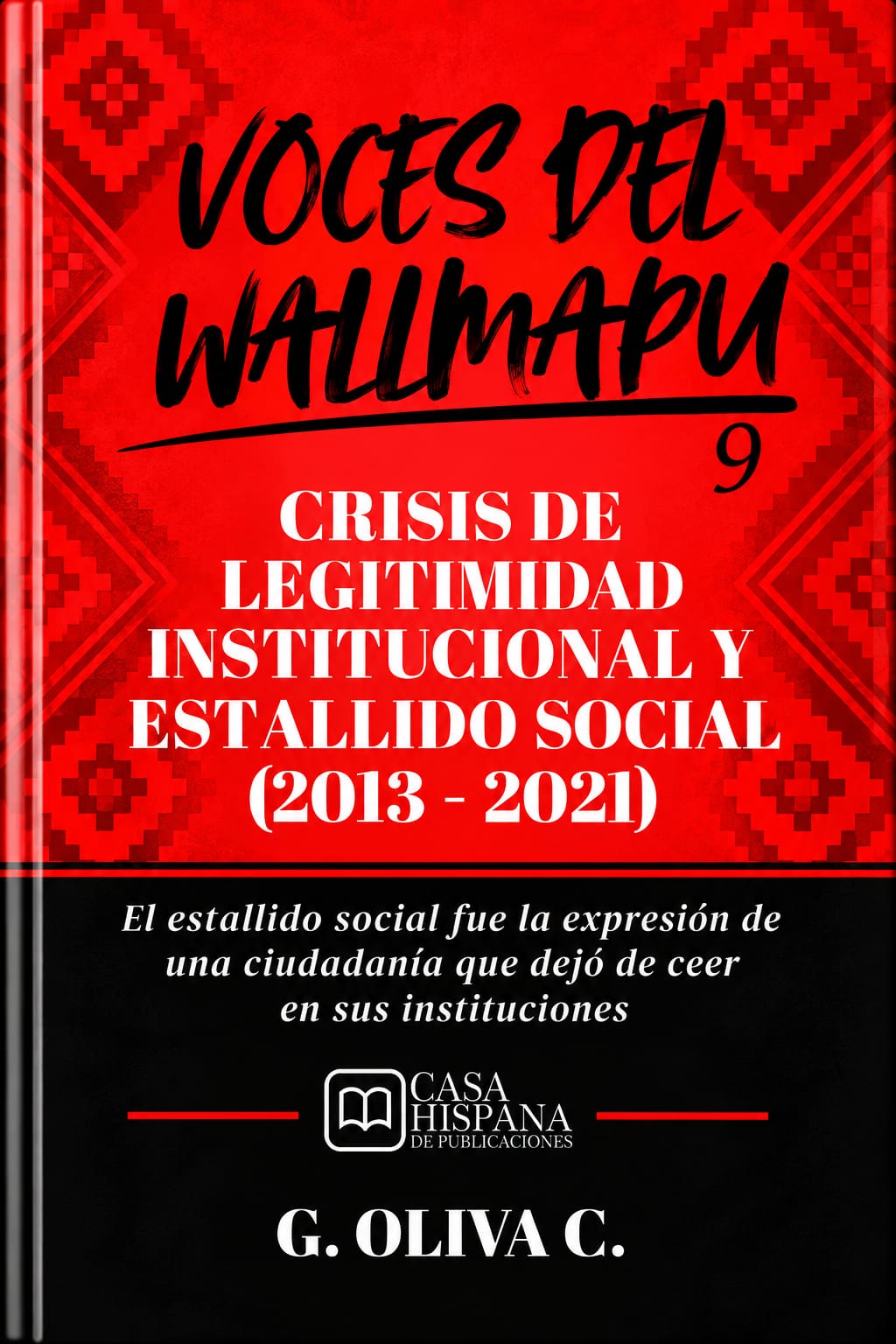
Crisis of Institutional Legitimacy and Social Uprising (2018–2021) examines one of the most intense and complex periods in Chile's recent history, situating the Mapuche question within a political and social crisis that reached far beyond relations between the State and Indigenous peoples. The central argument of this volume starts from a historical observation: by the end of the 2010s, the so-called State–Mapuche conflict could no longer be understood in isolation. It was embedded in a society that had begun to question deeply the legitimacy of its institutions, its accumulated inequalities, its forms of political representation and the State's capacity to answer historical demands for recognition, participation and social justice. The period opens symbolically with the death of Camilo Catrillanca on 14 November 2018 during a police operation in Temucuicui. The case caused deep public shock, especially once contradictions emerged between the first official accounts and the facts subsequently established by the investigation. Beyond its judicial consequences, the episode took on a political weight: it reopened the argument over the use of force, over police conduct in Mapuche communities and over the deteriorating trust between State institutions and Indigenous sectors. But what might at first have been read within the long history of the territorial conflict acquired, during 2019, a far greater national scope. 2019: when the crisis ceased to be sectoral. 18 October 2019 is a turning point in contemporary Chilean history. The protests that began in Santiago, preceded by students evading fares in response to the rise in public transport charges, spread rapidly across the country. The mobilisations went far beyond their initial trigger. Pensions, wages, education, health, indebtedness, inequality, the cost of living, access to social rights and distrust of the political elites began to converge in a heterogeneous protest. Chile entered what would later be called the social uprising. From a historical perspective, the significance of the process lies in the fact that it made an accumulated crisis of legitimacy visible. A large part of the citizenry was questioning not only particular public policies but the capacity of the institutional system to represent its demands. The crisis was therefore wider than a government. Wider than a party. And certainly wider than the Indigenous question. It was a crisis about the way broad sectors of society judged the workings of the political, economic and social model built over the preceding decades. The Mapuche presence within the uprising. One of the most striking features of the mobilisations was the extraordinary visibility of the Mapuche flag, the Wenufoye, on marches held even outside the territories of greatest Indigenous presence. Its use by non-Mapuche demonstrators is a sociological phenomenon that deserves attention. For different participants the flag carried different meanings: resistance, identity, criticism of centralism, recognition of Indigenous peoples or a questioning of historical relations of power. The Mapuche cause was thus beginning to be linked symbolically to a wider national critique. Precision is nonetheless necessary. The social uprising was not a Mapuche insurrection. Nor can it be claimed that Indigenous organisations shared a single reading of the protests. What happened was different: historical Indigenous demands found a space of resonance within a national crisis of representation and legitimacy. The Mapuche question ceased to appear solely as a problem of the Araucanía. It began to form part of the debate about what kind of State and society Chile wanted to build. Protest, violence and human rights. The social uprising was accompanied both by massive peaceful demonstrations and by grave episodes of violence, looting, arson and the destruction of infrastructure. At the same time, the conduct of the security forces generated numerous complaints of human rights violations. National and international bodies documented cases of excessive use of force, eye injuries, ill-treatment and other abuses. In December 2019 the Office of the United Nations High Commissioner for Human Rights concluded that there were reasonable grounds to hold that multiple human rights violations had been committed during the protests. Rigorous research must resist simplifying readings. Recognising human rights violations committed by State agents does not require denying the crimes and violent acts that took place during the uprising. Equally, recognising that there was violence during the protests does not justify State actions contrary to fundamental rights. The democratic State has at one and the same time the obligation to maintain public order and the obligation to respect human rights. That tension, visible for years in the Mapuche conflict, now appeared on a national scale. From the street to the constitutional process. The crisis finally produced a political response of enormous consequence. On 15 November 2019 representatives of much of the political system signed the Agreement for Social Peace and the New Constitution, which opened an institutional path for consulting the citizenry on the possibility of drafting a new Fundamental Charter. The plebiscite held on 25 October 2020 produced a large majority in favour of beginning a constitutional process: the Apruebo (Approve) option obtained approximately 78% of the valid votes cast. The Indigenous question then entered a political arena without precedent. What was under discussion was no longer only an Indigenous law, a territorial programme or a particular public policy. The place of Indigenous peoples within the constitutional architecture of the State was beginning to be debated. Constitutional recognition. Representation. Interculturality. Territory. Autonomy. Collective rights. Legal pluralism. Plurinationality. Concepts that for decades had remained mainly in academic, Indigenous or specialist circles began to form part of the national political conversation. Reserved seats: a historic change. In December 2020, 17 seats were reserved for representatives of Indigenous peoples within the Constitutional Convention that would be elected in 2021. Seven of them went to the Mapuche people. This was of enormous historical importance. For the first time, Indigenous representatives elected through a specific constitutional mechanism would take direct part in drawing up a proposal for a new Constitution. The change from earlier periods was plain. For much of republican history, Indigenous policy had been designed fundamentally about Indigenous peoples. Now the possibility of building proposals with direct Indigenous representation was institutionally open. This did not remove the differences that existed within the Mapuche world itself. Not all communities shared the same political projects. Not all supported plurinationality. Not all understood autonomy in the same way. Institutional participation demonstrated precisely the internal diversity of the Mapuche people. 2020–2021: pandemic and the continuation of the conflict. The COVID-19 pandemic profoundly altered the national scene during 2020. Health restrictions reduced mass mobilisations and shifted much political activity into other spaces. But the territorial conflict in the centre-south did not disappear. Occupations, arson attacks, confrontations and disputes over estates, forestry companies and territorial claims persisted. Discussion also continued about Mapuche prisoners and the conditions under which sentences were served, with particular visibility for the hunger strike carried out during 2020 by the machi (the ceremonial and healing authority) Celestino Córdova and other members of the communities. This demonstrated something fundamental: the constitutional process could open a new political path, but it did not suspend the existing conflicts over territory. The institutional order was advancing along one road. Territorial conflict continued along another. The crisis of trust. The word legitimacy is probably the central concept of this volume. An institution may act within the law and yet face a crisis of legitimacy when a large part of society ceases to trust it. During this period, trust in political, police and representative institutions was under deep strain. In the Mapuche case, that distrust had roots that ran deeper still. Occupation. Reducción (the reservation-like land settlements imposed by the Chilean State). Assimilation. Counter-reform. Limited recognition. Judicialisation. Criminalisation. Each stage had left a memory behind it. The problem of 2018–2021 was that this long-standing Indigenous distrust began to meet a general crisis of institutional trust across Chilean society. That is where the historical singularity of the period lies. From an Indigenous problem to a problem of the State. For decades the expression Mapuche problem had been used to describe the tensions in the south of Chile. This volume proposes to reverse the perspective. Perhaps the problem did not consist solely in asking what was happening with the Mapuche people. It was also necessary to ask what difficulties the Chilean State itself had in relating to its own historical, cultural and territorial diversity. The social uprising reinforced that reading. When millions of non-Indigenous citizens also questioned representation, inequality and institutional legitimacy, it became plain that some of the difficulties observed in the State–Mapuche relationship formed part of wider questions about the workings of Chilean democracy. This does not mean equating all demands. Mapuche history has territorial, cultural and legal specificities of its own. It means recognising that the Indigenous crisis and the national crisis began to meet within a common question: how is legitimacy to be rebuilt when important sectors of society consider that the institutions do not adequately represent them? Final consideration. Crisis of Institutional Legitimacy and Social Uprising (2018–2021) is a volume of transition within this history. The period began with the death of Camilo Catrillanca and ended with Indigenous representatives taking direct part in a Convention charged with drafting a constitutional proposal. Between those two events, Chile went through one of the greatest social crises since the return to democracy. The Mapuche question then ceased to occupy only the pages given over to security, land or Indigenous policy. It entered the centre of the constitutional debate. The country began to discuss not only how much land should be purchased or which programmes should be implemented, but far deeper questions: what it means to recognise a people; how to represent diversity politically; what relationship exists between territory and autonomy; and how far the State must be transformed in order to incorporate its Indigenous peoples institutionally. This period therefore represents something more than a new phase of the conflict. It represents the moment when the old Mapuche question met a general crisis of the Chilean political model. Indigenous demands could no longer be interpreted solely from the territorial periphery. They had reached the centre of the debate about the State. The process nonetheless remained open. Constitutional participation did not put an end to violence. Political recognition did not resolve the territorial demands. Greater visibility did not automatically produce greater trust. Chile thus reached the end of 2021 facing a historical paradox: never had Indigenous peoples held so great a presence in a contemporary constitutional discussion and, at the same time, the relationship between the State and sectors of the Mapuche world remained deeply strained. That contrast defines the stage. After more than a century of policies aimed successively at occupying, reducing, assimilating, integrating and administering the Indigenous question, Chile was at last beginning to debate a different question: is it enough to recognise Indigenous peoples within the existing State, or does that recognition also demand a revision of the way the State itself understands its history, its territory, its diversity and its democracy? That question would remain open at the close of 2021 and would lead directly to the next stage: the constitutional process, the debate on plurinationality, the constitutional rejection of 2022 and the subsequent reconfiguration of the relationship between the State, Chilean society and the Mapuche people…
Category
- SOCIAL SCIENCES
- HISTORY
- INDIGENOUS STUDIES
- MAPUCHE HISTORY
- STATE, TERRITORY, CONFLICT AND INDIGENOUS RIGHTS
Rights for this book
We turn publishing rights into international growth, connecting authors and publishers with new markets, new readers and new partners around the world.
Technical details
- Title
- Crisis de Legitimidad Institucional y Estallido Social (2013–2021)
- Author
- G. Oliva C.
- Imprint
- Grupo Editorial Casa Hispana de Publicaciones
- Size
- 15x23cms
- Edition
- 1st edition, 2024
- Published in
- Chile
- Year of publication
- 2025
- Available languages
- Spanish, English, German, Portuguese
- Binding
- Paperback with flaps
- Pages
- 548
- Format
- Print book
- Language
- Spanish